KRX Value-Up Program Enters Second Year with Record Shareholder Returns, but Participation Gap Persists
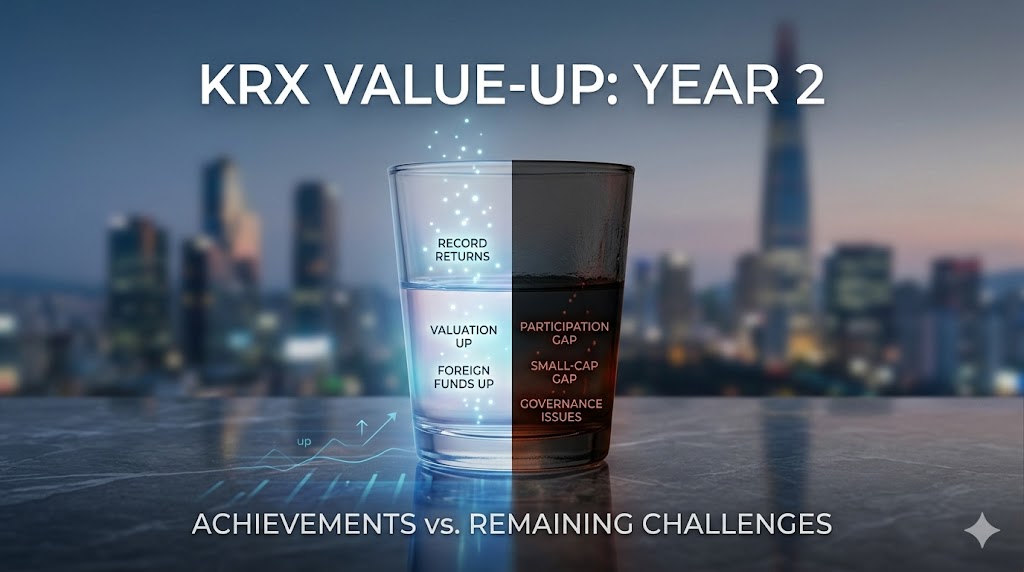
The corporate value-up program led by the Korea Exchange (KRX) has entered its second year with notable gains in shareholder returns and market performance. However, limited participation among listed firms and a widening gap between large and smaller companies remain key challenges.
174 Companies Disclose Value-Up Plans
Since the program’s launch in May 2024, a cumulative 174 listed companies had submitted corporate value enhancement plans as of end-2025, including 171 full disclosures and three preliminary filings.
Companies that filed full disclosures account for 44.5% of the total market capitalization on the main exchange. Yet participation remains limited in numerical terms, representing just over 6% of roughly 2,600 listed firms.
The distribution is also skewed by size. Among companies that submitted full disclosures, 109 firms, or 63.7%, have a market capitalization exceeding KRW 1 trillion. In contrast, only nine firms with a market cap below KRW 100 billion participated.
Record Buybacks and Cancellations
Shareholder return indicators improved sharply in 2025.
Treasury share buybacks totaled KRW 20.1 trillion, while share cancellations reached KRW 21.4 trillion — both record highs. Compared with 2023, buybacks increased about 2.5 times and cancellations roughly 4.5 times.
Cash dividends amounted to KRW 50.9 trillion, up 11.1% from the previous year. Combined with buybacks and cancellations, total shareholder returns surpassed KRW 90 trillion.
Large-cap companies led the expansion in shareholder returns, with a series of treasury share cancellations and special dividend announcements contributing to the overall increase.
Value-Up Index Outperforms KOSPI
The KRX Korea Value-Up Index closed 2025 at 1,797.52 points, up 89.4% from a year earlier. The gain outpaced the 75.6% rise in the KOSPI by 13.8 percentage points.
Assets under management of value-up exchange-traded funds (ETFs) grew to KRW 1.3 trillion, marking a 162.5% increase from their initial launch size. The proportion of foreign investors’ trading value also expanded from 9.1% to 18.8%.
Valuation metrics improved as well. Based on the MSCI Korea Index, the price-to-book ratio (PBR) rose from 0.88 times to 1.59 times, while the price-to-earnings ratio (PER) increased from 11.37 times to 17.47 times over the same period, suggesting a partial easing of the so-called “Korea discount.”
However, part of the ETF asset growth reflected valuation gains driven by the sharp rise in the underlying index, rather than net new capital inflows.
Third Year to Focus on Institutional Reinforcement
Entering its third year, the KRX plans to revise its corporate value-up guidelines in the first quarter to reflect amendments to commercial law and strengthen governance-related requirements.
In June, the exchange will conduct a regular index rebalancing, placing greater emphasis on companies that actively implement and disclose value-up plans. It also intends to expand disclosure and governance consulting for small and mid-sized listed firms and introduce recognition programs for exemplary participants.
While the program has delivered measurable improvements in shareholder returns and market performance, broadening participation across the wider corporate sector remains a critical task for its long-term consolidation.